A Solana full-node on a tablet has just been shown to be able to go from zero to a fully synced node in less than 10 seconds using less than one CPU core. This demo, spearheaded by Firedancer developer Ritchie Patel and co-founded by Anatoly Yakovenko, brings back into focus the debate around whether blockchains should be accessible.
The demo utilised 5G and 20GB RAM. The 10 second benchmark includes boot time, compiling in parallel, snapshot syncing and voting. This is usually a much heavier set up. Yakovenko responded to the demo with a simple response to Bankless co-founder David Hoffman, “We did it”.
This goes back to January 2023 when David Hoffman was arguing that blockchains must be able to be run on small rigs to ensure sustainability and a strong culture. At the time, the specs required to run a node on Solana were criticised for not meeting this goal. However, this demo shows that nodes can be run on a tablet.
It is worth noting that whilst the hardware runs on less than one core of processing power, the node requires a lot of RAM to run (20GB), and uses 5G. What’s more, the 10 second benchmark is achieved through snapshot syncing. This means the node can start again from the last point in the network, but does not need to process all historical transactions. It is not running in a live environment.
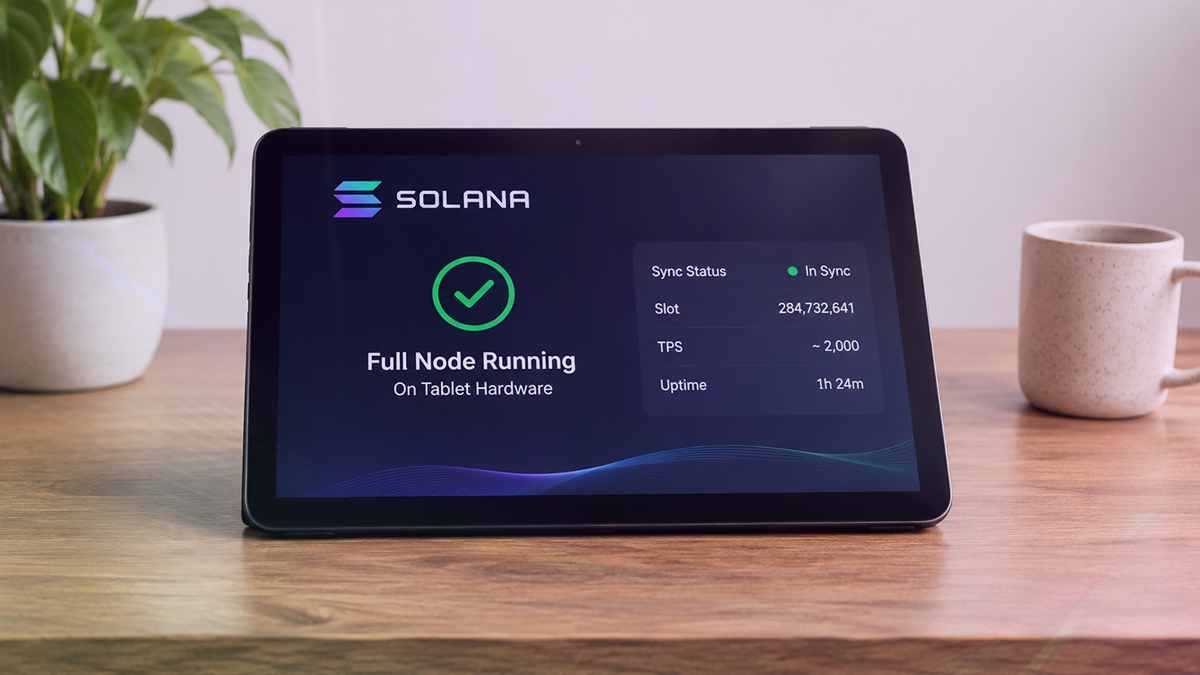
The recommendations from Anza, who developed the Agave client, have not changed. They still recommend a minimum of 12 cores, 256GB RAM, fast storage and 2 Gbit/s symmetrical networking for staking validators. Whilst the demo was run on a tablet at a conference floor, it is not the same as having a node that will be constantly producing blocks. The demonstration does not show how long the node could run for, constantly produce blocks or handle high volumes of transactions.
Symbolically this is a big win for Solana. Firedancer, developed by Jump Crypto as an independent validator client, has already handled tens of millions of transactions on the mainnet. This adds another visual to the argument that clients are becoming more efficient. The difference between consumer devices and validator infrastructure may be reducing.
However, whether this will actually make it easier to run a node depends on how well it performs in the real world. It will need to be stable in the long term and handle the load of the network.
More crypto news:
 Hardware Wallets Undergo Supply Chain Attacks: Is Open-Source Linux the Answer?
 Bitcoin Cash Outperforms Market with 57% Weekly Gain Ahead of CME Launch
 Brazil Leads the World in Crypto Adoption as Stablecoins Reshape the Financial Ecosystem
 Chainlink Secures Strategic Alliance with Infosys to Bridge 1.7 Billion Banking Accounts to Onchain Finance
 Trump’s Accounts Just Made a Big Move in the Bitcoin Market